Lesson 1: Introduction to Generative Neural Networks
Welcome to the first lesson of our course! Today, we will dive into the world of generative artificial intelligence, learn what these tools are, how they work, and what opportunities they open up for us. Our goal is to understand the basics and figure out where and how to use neural networks effectively.
What are generative neural networks?
ChatGPT, Claude, Gemini, and similar models are artificial intelligence systems capable of generating text based on user prompts. They are all based on the GPT (Generative Pretrained Transformer) architecture or its advanced analogs, trained on massive amounts of text data from the internet, and can create new texts by imitating the style and tone of a given sample.
Modern neural networks have gone through several generations of development. With each new version, the models become more powerful and accurate due to an increased number of parameters and expanded training data.
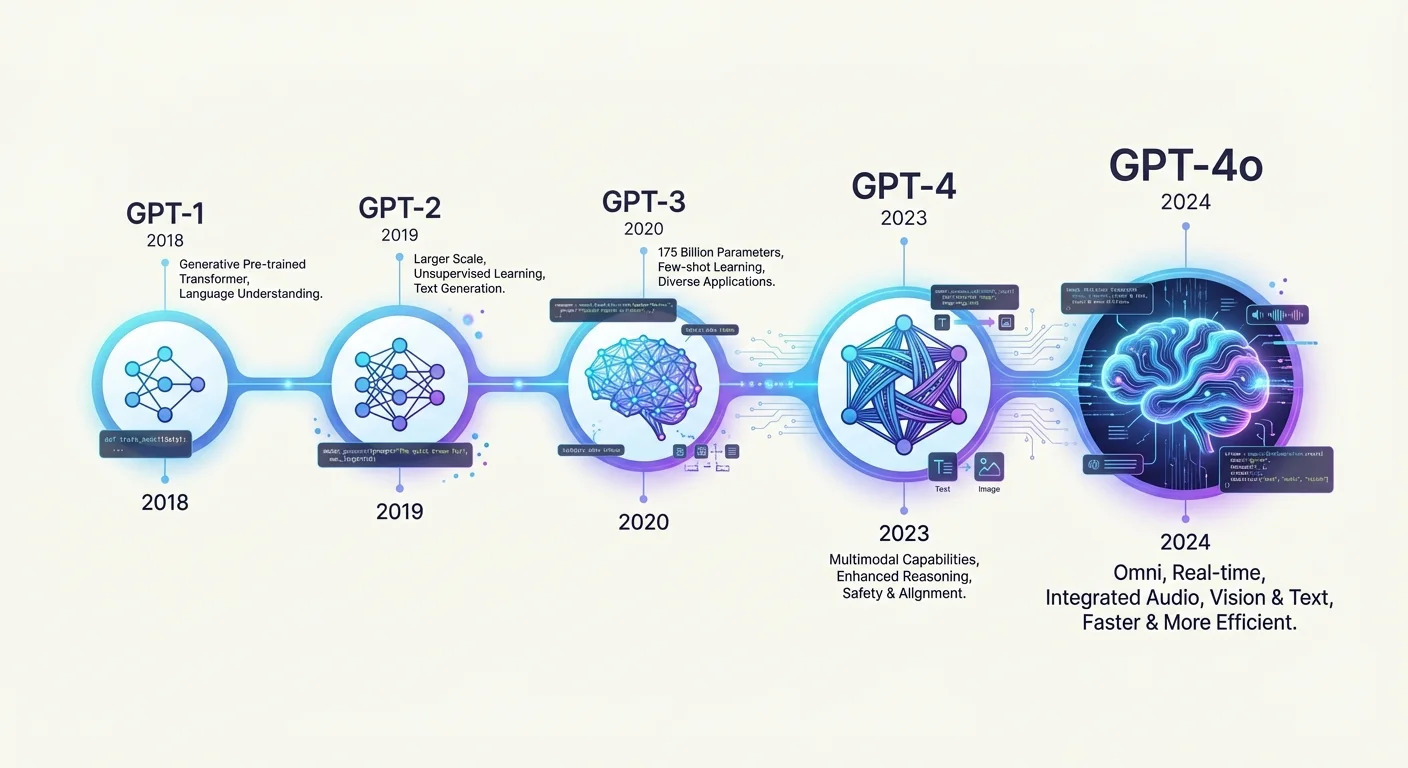
During the training of GPT-3, about 570 GB of text data was used—this is roughly equivalent to the text in 150,000 average-sized books. This is exactly why the models are capable of generating answers to such a wide variety of prompts. Just imagine the volume of data involved in the latest versions!
Modern flagship models have a significantly larger number of parameters compared to their predecessors, making them more powerful and capable of generating accurate and diverse responses. They confidently handle complex language structures, grasp context, and can solve multi-step tasks.
Previous generations of neural networks gained popularity due to their ability to create texts that seem natural and convincing. The latest versions represent an even more powerful tool, capable of improving and accelerating processes in writing, education, research, and development.
How neural networks differ from search engines
Neural networks and traditional search engines are two fundamentally different tools, and although both work with information, their approaches and capabilities differ significantly.
A search engine indexes millions of web pages and offers you the most relevant links for your query. You get a set of sources from which you have to piece together the answer yourself.
Until recently, neural networks could not search for information on the internet and answered based solely on their training data. However, most of the latest models now have a built-in web search feature, making them practically indispensable.
More and more people are starting to use generative AI instead of traditional search because it not only finds links but also independently selects the most relevant information, highlights the main points, and performs any task—from preparing reports to analytics.
However, it is worth remembering that neural networks can sometimes provide inaccurate information, as their main goal is to answer your question and do so convincingly. Therefore, we want to emphasize once again the importance of verifying the data received from AI, especially when the accuracy of this information is critical.
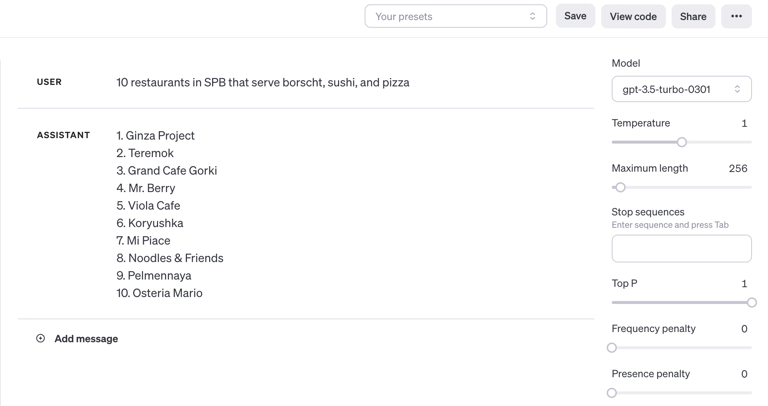
If you enter the query "10 restaurants in St. Petersburg that serve borscht, sushi, and pizza" into a search engine, you will get several links, none of which will give a direct answer. You will have to compile the information from different sources.

If you ask a neural network the same question, it will generate a structured answer, but it will not be based on current or verified data, only on the model's general knowledge.
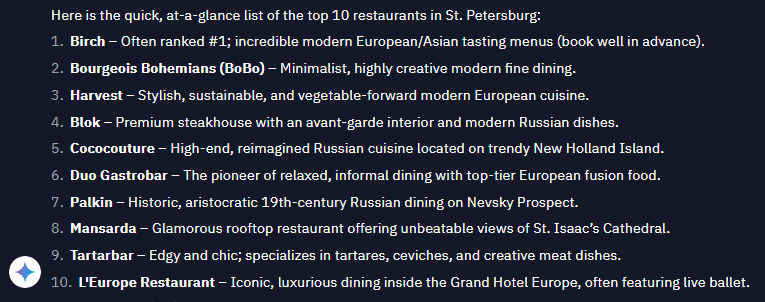
However, by enabling the web search feature, you will get a completely different result. The neural network will review links with restaurant selections and honestly inform you if it cannot find a place that meets all three criteria. At the same time, it will add links to maps with restaurants of the desired category nearby.
Capabilities of generative neural networks
Modern neural networks possess unique capabilities that make them some of the most powerful and flexible tools for life and work. Here are the key ones:
-
Text generation. Neural networks are capable of creating long and coherent texts based on the data they were trained on. They write articles, blogs, stories, poems, and even technical documents with a certain degree of accuracy.
-
Iterative refinement. You can refine and deepen the model's answers by asking follow-up questions. This is especially useful when looking for detailed information or trying to articulate complex ideas.
-
Conversational mode. Neural networks are capable of conducting natural conversations, providing a human-like communication style. This makes them an excellent tool for virtual assistants and chatbots.
-
Applying instructions. Models can take instructions in a prompt and follow them when generating a response. You control exactly how the neural network will create the text and adapt it to your tasks.
-
Creativity control. Using parameters like temperature and top_p, you can adjust the degree of creativity in the output—from precise and detailed answers to free and creative ones.
-
Contradictory instructions. Neural networks are capable of processing contradictory inputs and generating adequate text based on them. This provides flexibility in communication and the ability to consider different points of view.
Areas of application
Since neural networks are trained on massive amounts of data, they can be used as an expert in almost any field. Here are some of them:
-
Education and scientific research. An indispensable assistant for students and researchers: it explains complex concepts, helps with homework, suggests essay structures, and assists in writing scientific papers.
For example, a history student used a neural network to analyze dozens of sources and compile a literature review for a term paper in one evening instead of three days of independent work.
-
Creativity. This opens up a huge field of activity. The application of neural networks in art is limited only by your imagination. Create stories, scripts, poems, songs, ideas for artwork, and much more.
For example, an aspiring writer used a neural network to flesh out the personalities of ten characters for their novel and write out their speech patterns—a task that used to take weeks of creative agony.
-
Business. Assistance in creating marketing content, generating product ideas, writing reports, analyzing data, and even automating customer service.
For example, a small coffee shop owner used a neural network to prepare a social media content plan for a month ahead in just an hour, adapting the style of the materials to their audience.
-
Entertainment. Creating game scripts, dialogues for video games, texts for quests, and interactive stories.
For example, a board game developer generated 50 unique event cards for their RPG in just one evening, tested the ideas, and selected the best ones.
-
Programming. Assistance in writing code, documenting projects, as well as finding solutions to technical problems and bugs.
For example, a junior developer used a neural network to figure out an unfamiliar framework over the weekend and prepared a working prototype of an app that they had planned to spend a month writing.
-
Health and well-being. Neural networks can be used as a tool to improve diet or sleep, reduce stress, and enhance well-being—they offer relaxation techniques, healthy recipes, and much more.
For example, a person with an irregular schedule used a neural network to create a personalized meal plan and daily routine that took their shifts into account and helped them fix their sleep in two weeks.
We have just begun our journey into the world of AI and have already discovered a huge number of possibilities! This versatile tool can help you in a wide variety of fields, and we hope that with each new lesson, you will master its capabilities more and more. Keep experimenting, look for new ways to use AIs like ChatGPT, and don't be afraid to try something new. We are sure this will be an exciting journey, and we look forward to seeing you in the next lesson!