Lesson 3: The Art of Creating Theses and Dissertations
Creating a thesis or dissertation is an exceptionally important process in which you transform from a student into a researcher. This process requires extensive research, the ability to conduct literature reviews, strict structuring, and editing. Let's go step by step and try to create a plan that will help you write such serious academic works as a thesis and a dissertation.
Generating a Thesis Topic
Defining a topic is not just choosing an area that interests you. It is a commitment to conduct thorough research within that area, present your findings, and go through the defense process. This is the field of knowledge you will likely be studying for several months or even years. Your research question determines what your research process will look like, what literature you will use, and what your conclusions will be.
So, how do you choose a good research question? It should meet several criteria:
- Relevance: your question should reflect current trends and issues in your field.
- Clarity: it should be clear from your question exactly what you intend to research. Avoid questions that are too broad or too specific.
- Feasibility: make sure you have the resources and time to answer the question. If your question is too broad or complex, you may find it difficult to manage the work.
- Significance: your question should be important and interesting both to you and to your academic community.
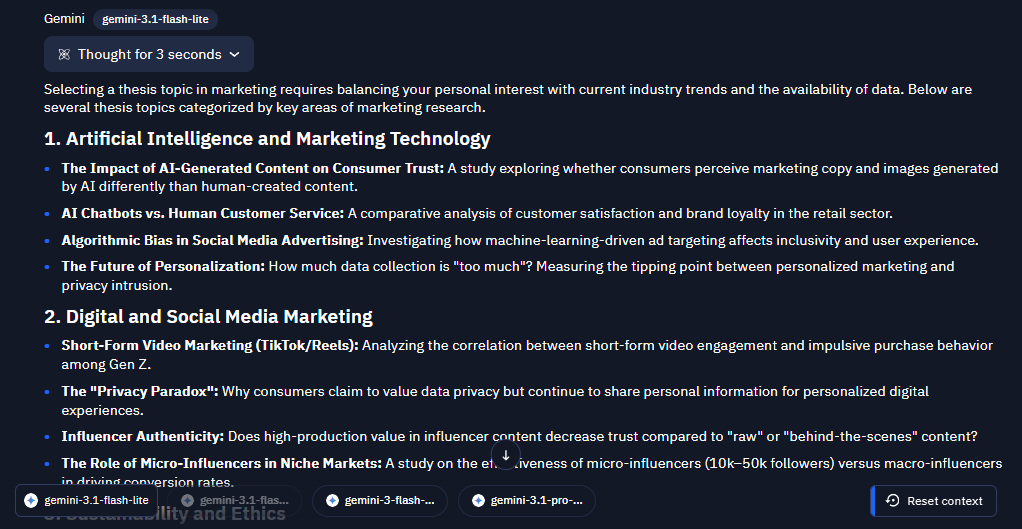
Ask your question like this: "Suggest thesis topics on marketing." Artificial intelligence will apply its algorithms and offer you a list of potential topics. These can be topics based on current trends in marketing or broader topics that can be explored from different angles.
In response to such a prompt, Claude suggested the following:
Evaluating Topics
Once you receive a list of potential topics, you will need to evaluate them based on various criteria. How relevant is this topic? How well does it suit you? What are the prospects for conducting research in this area? What will it give you in the long run? Claude can help you evaluate these topics by suggesting self-assessment questions or providing additional information about each topic.
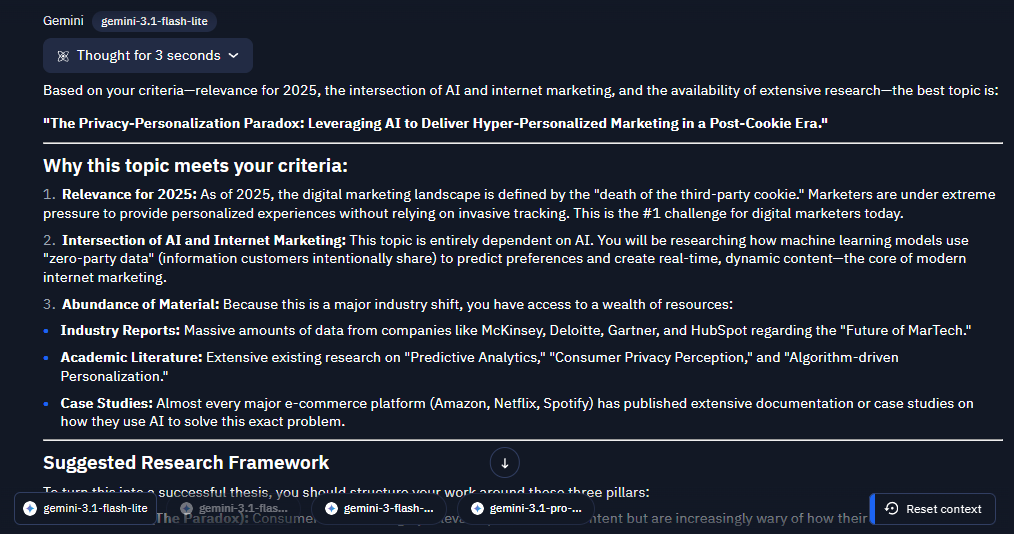
For example, ask it: "Choose one of the suggested topics based on the following criteria: 1. The topic must be relevant for 2025, 2. It is related to internet marketing and artificial intelligence, 3. This topic already has a lot of materials to work with."
Answer:
Creating the Outline
The outline of a thesis is a kind of roadmap that will help you structure your research and ensure its logical flow. It is a list of the main sections, subsections, and key points that you plan to cover in your work. The main sections of a thesis may include an introduction, literature review, methodology, results, discussion, and conclusion. However, the specific structure may vary depending on the requirements of your educational institution and the specifics of the research itself.
Claude can help you generate the basic structure of your thesis:
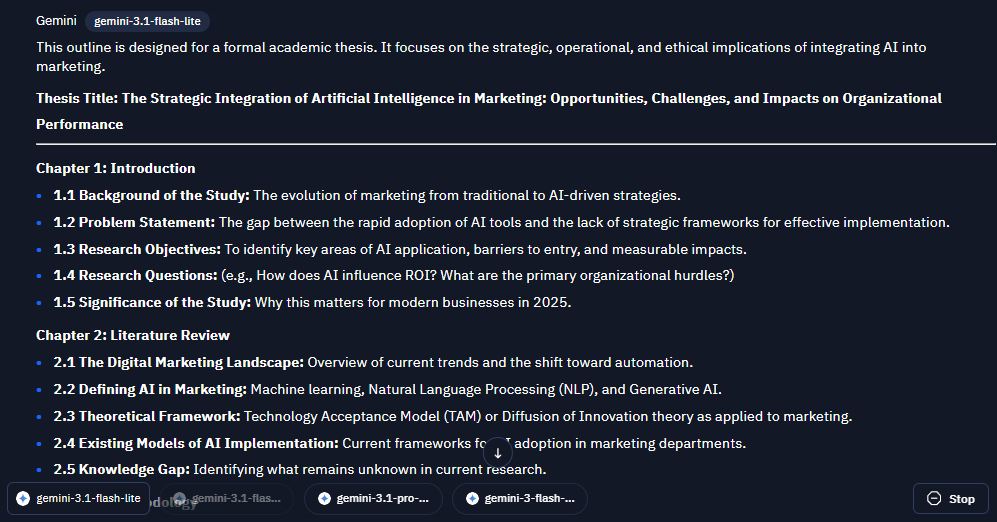
"Create an outline for a thesis on the topic 'Implementation of Artificial Intelligence in a Company's Marketing Activities', including headings and subheadings."
Here is what it might suggest:
Iteration and Refinement
The process of creating an outline often requires multiple iterations and refinements. You can continue asking questions and "tweaking" them with Claude until you achieve the desired result. Remember that an outline is a flexible structure, and you can always make changes if needed during the writing process.
Conducting a Literature Review and Developing a Methodology
A literature review and methodology development are two important components of any research project. The literature review allows you to back up your work with existing research, while the methodology shows exactly how you plan to conduct your study.
- Literature Review
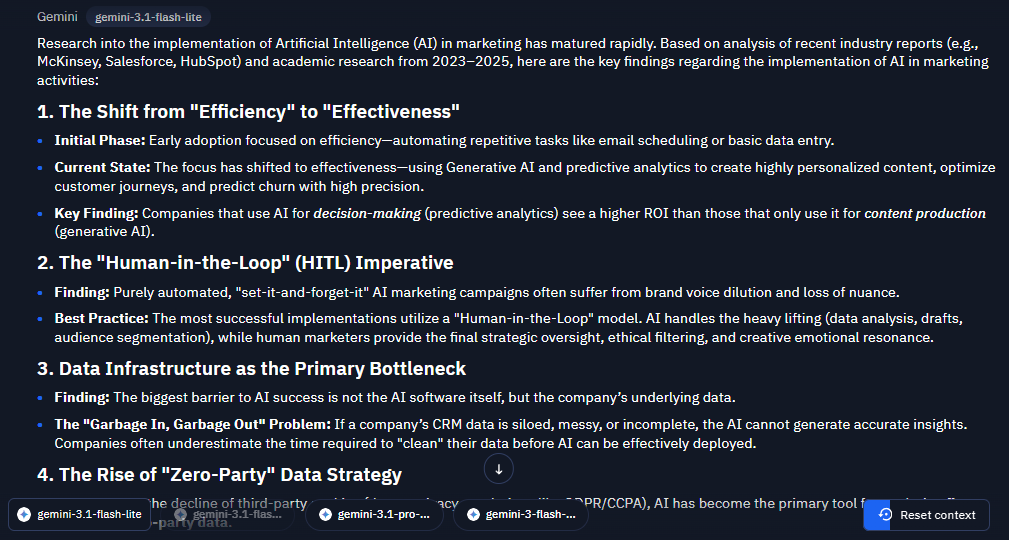
This process is not just reading: it is an active process of analyzing and synthesizing ideas and theories that already exist in your field. To prepare a literature review, you must look through a large number of studies and articles related to your topic and find out what ideas and approaches have already been explored. Here, Claude can help you process large volumes of information by extracting and analyzing key points from various sources, saving you time for the actual writing of the paper.
Example
"Provide key findings from research on the topic 'Implementation of Artificial Intelligence in a Company's Marketing Activities'."
- Developing a Methodology
Methodology is the way you plan to research your topic. This may include choosing appropriate methods for data collection and analysis, as well as explaining why these methods are the most suitable for your research.
Example
"What research methods are best suited for the topic 'Implementation of Artificial Intelligence in a Company's Marketing Activities'?", or "Can you compare quantitative and qualitative research methods?"
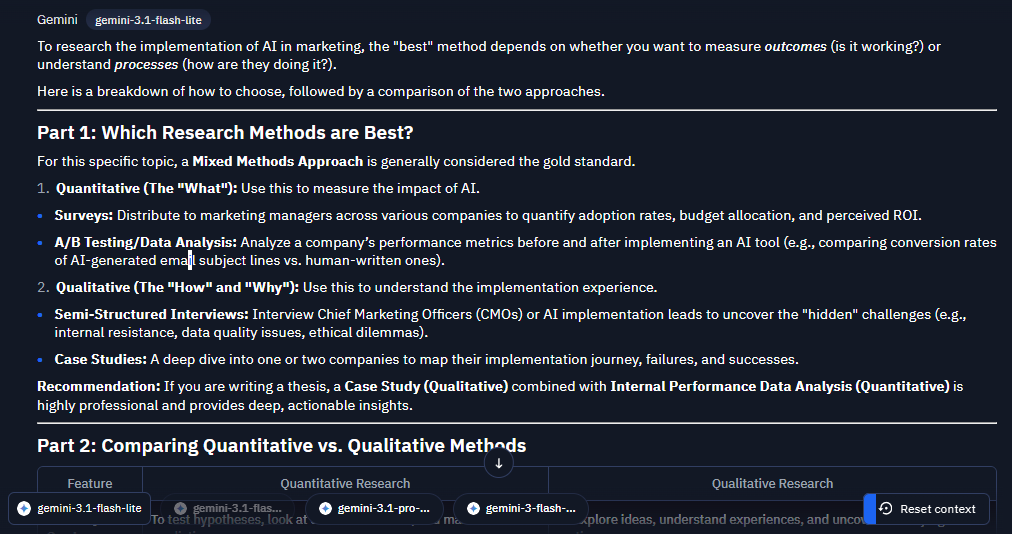
In addition, Claude can help you understand the specifics of applying various methods in practice by providing examples of their use in past studies.
Together, these two stages create the foundation for your research and help ensure its quality and validity.
Starting to Write and Edit
Writing and editing are the last two stages, but they are no less important. Your goal is to create a clear, structured, and well-argued text that answers your research questions.
- Writing
From this point, once you have a foundation in the form of an outline, you can start writing the text. Begin with the general structure: introduction, main chapters, conclusion. Each chapter should have sections and subsections that help present your information logically and consistently.
Here, Claude can become your assistant in formulating ideas, sentences, and paragraphs for each section. Ask questions related to your topic and get detailed answers that can be used in the text of your thesis.
For example, you can prompt: "Write an introduction for my research on AI in marketing" or "Explain how the implementation of AI affects company efficiency."
At the same time, always check the received information for accuracy and relevance.
- Editing
After writing the research, it is very important to edit and proofread it. As we mentioned earlier, this includes checking grammar and spelling, style and format, logic and structure, as well as the completeness and accuracy of the information presented. Claude will point out potential issues in your text and suggest improvements.
You can ask: "Check my work for grammatical errors" or "Help me improve the structure of my argument."
These two stages help ensure that your work is clearly articulated, well-structured, and free of errors.
Combating Plagiarism
Every researcher must respect the intellectual property of others and honestly acknowledge the contributions of others to their work. Plagiarism is a serious violation of academic ethics and should be avoided in any scientific work. It is important to note that unintentional plagiarism is still considered plagiarism, so learning and understanding what constitutes plagiarism is a key aspect of preparing a research project.
- Plagiarism Checking:
There are various tools and services for checking text for plagiarism. They allow you to see how original your text is and track any matches with other published works. Using such tools can be useful for identifying potential issues before submitting your work.
- Paraphrasing:
Sometimes, to increase originality, you may need to paraphrase ideas taken from other sources. Claude can help you rephrase ideas in a way that preserves their original meaning while articulating them uniquely and originally. We have already discussed this in previous lessons, but we consider it important to remind you again.
Remember that honesty and sincerity regarding the work of others is an important aspect of scientific work. Combating plagiarism not only helps preserve your academic reputation but also supports a healthy and innovative scientific environment.
Creating a Bibliography
Creating a bibliography is an important part of any research work. It shows which sources you relied on during your research and allows other scholars to access these sources if they want to delve deeper into the topic.
- Collecting Sources:
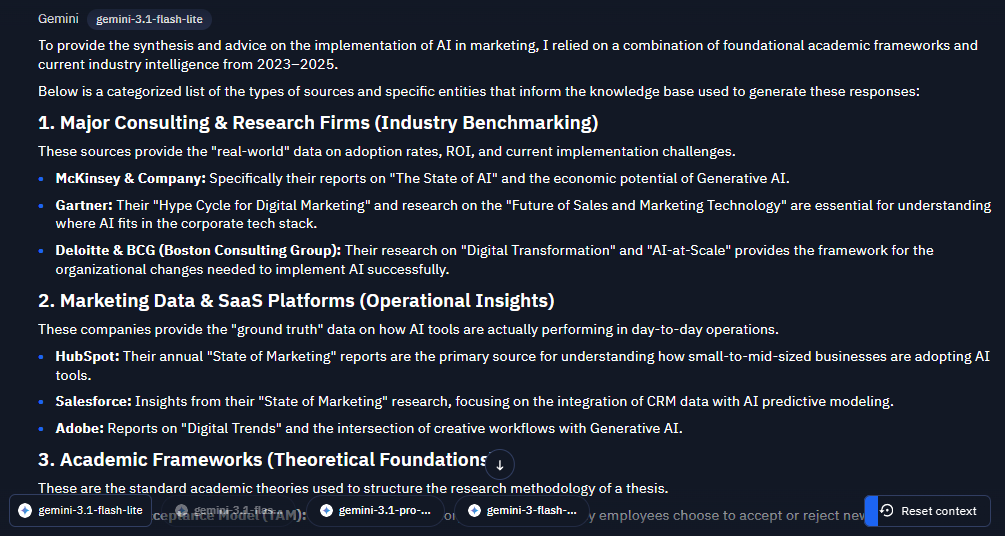
During your research, you will likely encounter many different sources—books, articles, websites, videos, etc. With Claude, you can gather all these sources in one place. Simply ask the artificial intelligence to provide the sources it relied on when formulating its answers, and add them to your list.
For example, let's make the following prompt:
“Write me a list of sources you relied on when formulating answers on the topic 'Implementation of Artificial Intelligence in a Company's Marketing Activities'.”
- Formatting Sources:
Each source in your reference list must be formatted according to a specific citation style. Formatting rules can be complex and vary from university to university.
An example prompt could be: "Format the list of sources according to the formatting rules for theses." Claude will easily handle this task, and even more so if you provide it with an example or a detailed explanation:
- Verifying Sources:
After compiling the reference list, it is important to check it thoroughly. Make sure that each source is formatted correctly and that you actually used this source in your work. Additionally, ensure that your sources are reliable and authoritative. This will help maintain the quality of your research and the persuasiveness of your arguments.
Creating a reference list is not just a mandatory part of the work; it is also a way to show respect for the work of other scholars and demonstrate your commitment to academic integrity.
Preparing for the Defense
Defending your thesis is your chance to demonstrate your understanding of the topic, justify your approach to the research, and present your findings. With Claude acting as a public speaking coach, you can prepare for this important event.
- Creating a Presentation and Preparing for Potential Questions
Using Claude can help formulate the main points of your presentation and create compelling slides. You can ask questions related to how best to structure your presentation, what visual materials to use, and how to connect your ideas into a clear and coherent narrative.
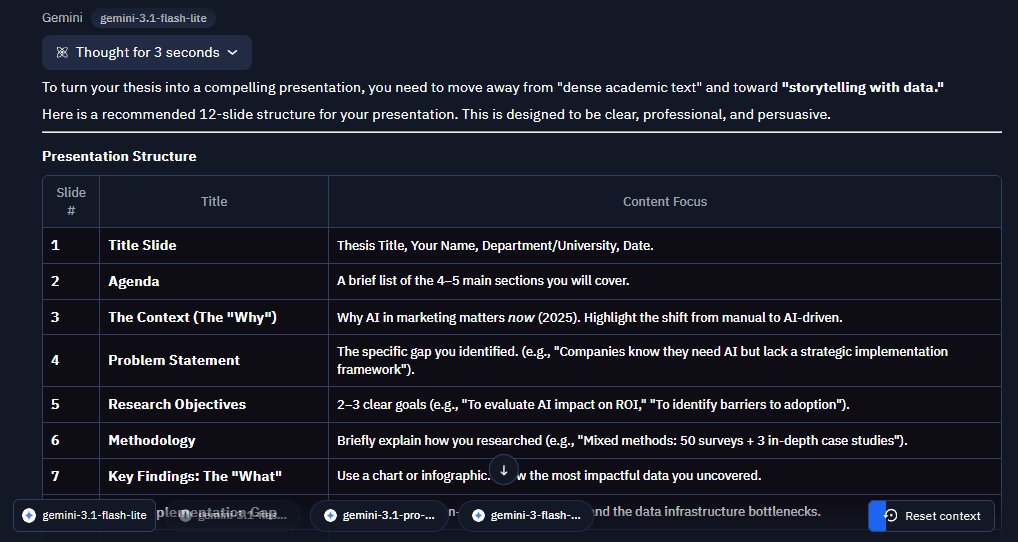
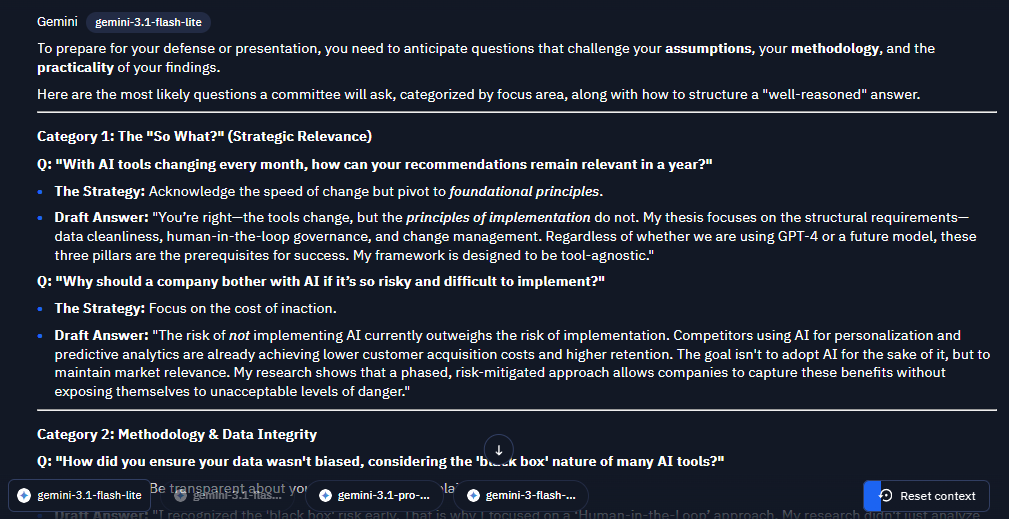
And since you will have to answer questions from the committee after your presentation, this can be an unpredictable moment, but with Claude, you can prepare in advance. Try to formulate potential questions and ask the AI to help you prepare well-reasoned answers.
Reflection and Passing Knowledge to Future Researchers
After completing your project and defending your work, it is time for reflection. This is an important stage that allows you to draw valuable lessons from your research experience.
- Analyzing the Experience:
Analyze the entire process of writing your thesis. What went well? Where did difficulties arise? What would you do differently if you were starting all over again? Write down your thoughts and conclusions using Claude as an interactive tool for reflection.
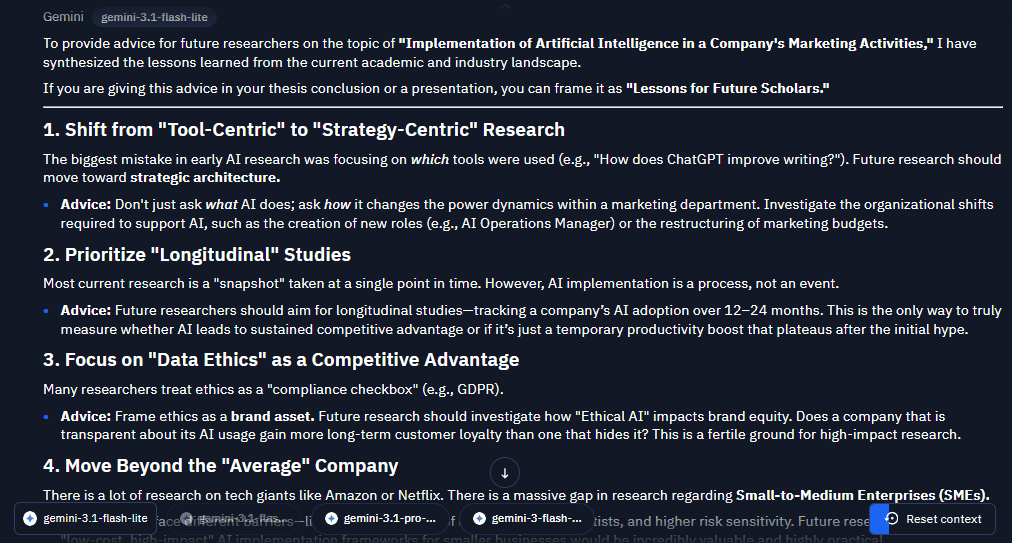
- Advice for Future Researchers:
Based on your experience, share advice for future researchers. Perhaps you discovered some non-obvious difficulties or found effective ways to handle certain tasks. Your observations and recommendations can be very valuable for those just starting their research journey, and AI can help you articulate them.
Example
“What advice can be given to future researchers on the topic 'Implementation of Artificial Intelligence in a Company's Marketing Activities'?”
Answer:
The neural network helps save time, deepen analysis, and improve the quality of your work, but success depends on your critical approach and academic integrity. Use Claude as a tool to strengthen your ideas, avoid plagiarism, and respect the work of other scholars. Let this process be not only a challenge but also an opportunity to unlock your academic potential!