Lesson 1: Using Claude in the Learning Process
The field of education is constantly evolving and adapting to new technologies, and AI is becoming an integral part of this process. As students, we constantly face the need to research new topics, write high-quality reports and essays, and effectively manage our time and resources.
Our goal is to give you concrete and practical tools for using neural networks in your educational journey. We guarantee that these skills will be useful not only for your studies but also for your professional life. So, let's get started!
A Brief Overview of Claude
In this section, we will get acquainted with another powerful neural network - Claude 3.7 Sonnet. This model has a large number of advantages over ChatGPT; let's look at the main ones:
- Wide range of tasks: It not only writes texts and answers questions but also generates ideas, solves math problems, analyzes data, and writes code. In other words, it is a full-fledged AI assistant for all occasions, capable of replacing an entire team of specialists.
- Support for various data formats and dozens of languages: In addition to working with text, it can process images, graphs, tables, and diagrams. Plus, Claude speaks dozens of languages fluently - from familiar European ones to exotic Eastern ones. It can switch between them right during the dialogue, understanding linguistic nuances and features.
- "No" to templates: In direct comparisons across various tasks, Claude often provides more detailed, well-reasoned, and simply better-formulated answers. It grasps context better, adapts to the communication style, and follows instructions more precisely, whereas ChatGPT more often provides templated text options.
- Strict adherence to ethical principles: It categorically refuses to generate dangerous, offensive, or discriminatory content, even if persistently asked to do so. ChatGPT, on the other hand, is more lenient and willing to play along with the user in some questionable scenarios.
How Claude can be applied in studies:
- Improving understanding and knowledge retention: It can help in studying complex material by providing explanations in a more accessible format. In addition, it can be used to prepare reviews and summaries that will help absorb and consolidate knowledge.
- Conducting research: It can assist in finding information and scientific articles, suggest research topics, and help formulate research questions.
- Help with assignments: Claude can assist in completing academic assignments by providing ideas, hints, and directions for further work.
- Academic writing: It can help in creating academic texts, supporting the creation of structured text, developing theses and arguments, and working with references and citations.
- Practicing foreign languages: It can be used to practice foreign languages. You can have conversations in any language supported by the model, receiving instant feedback and corrections from the AI, or learn new words.
- Exam preparation: Claude can help with exam preparation by reviewing exam topics and suggesting a study plan or practice questions.
This tool opens up new possibilities for quality education while remaining a reliable and ethical assistant. The main thing is to learn how to use its potential as effectively as possible. Let's look at its capabilities through examples:
Assistance with research work
Claude can help organize your research work by suggesting possible sources and materials to study, key terms, or historical context.
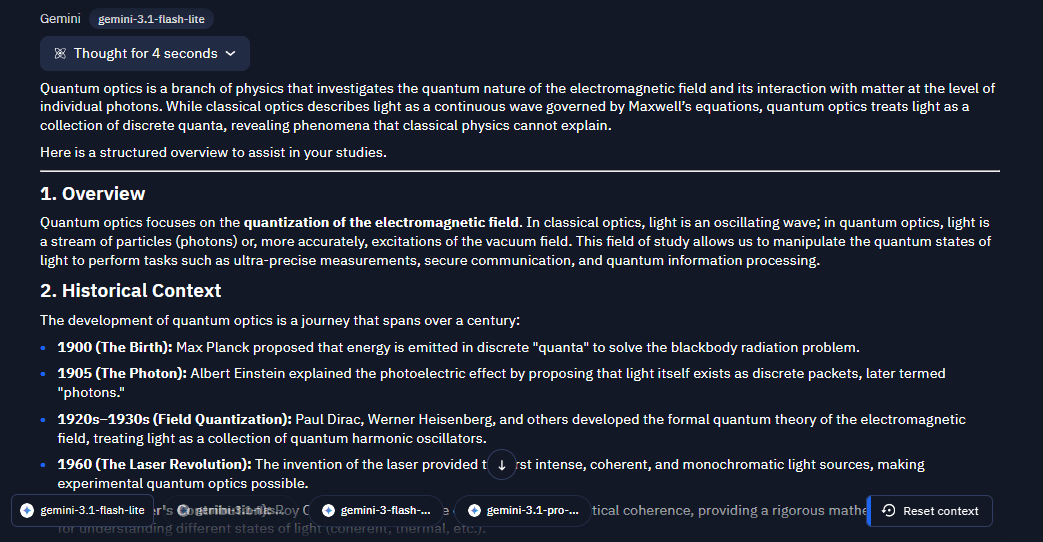
For clarity, let's turn to the topic of "Quantum optics" and ask Claude to help us. We will make the following request: "I am studying the topic 'Quantum optics'. Give a brief overview, provide definitions of key terms, historical context, and other details." And we get the following result:
Creating document structures
Claude can help create a structure for your research project or report, organizing materials into a logical sequence. This significantly speeds up the planning process and allows you to focus on the content of the research.
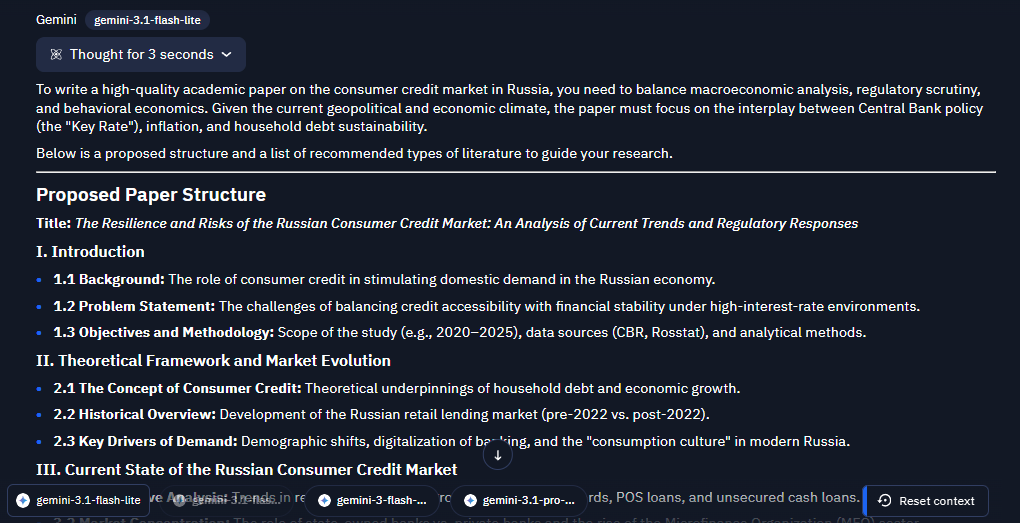
Let's give the neural network the following request:
"I am writing an academic paper in economics on the topic 'The current state of the consumer credit market in Russia'. Propose a detailed structure for the paper with sections and subsections, as well as a list of recommended literature at the end."
Citations and bibliography generation
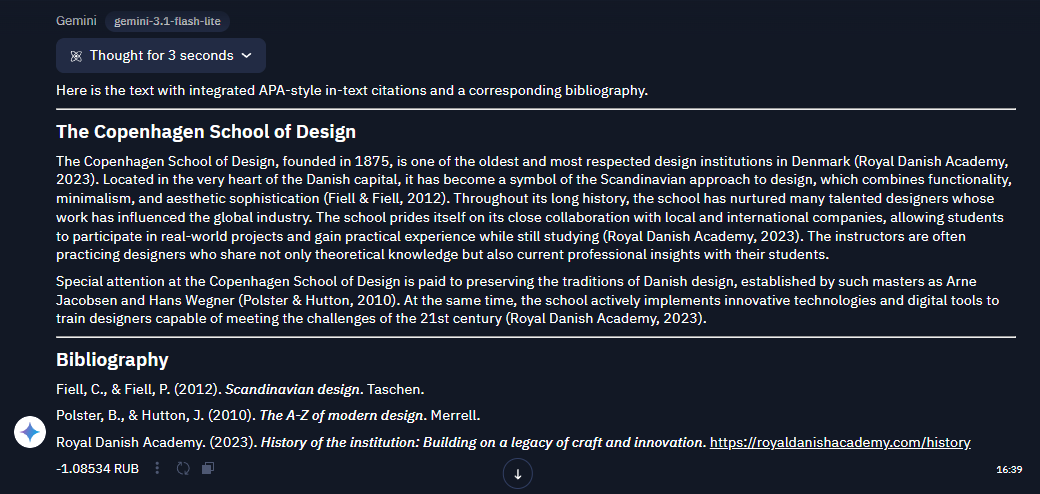
When writing dissertations or reports, Claude can help format references and bibliographies in accordance with academic style requirements (APA, MLA, Chicago, etc.).
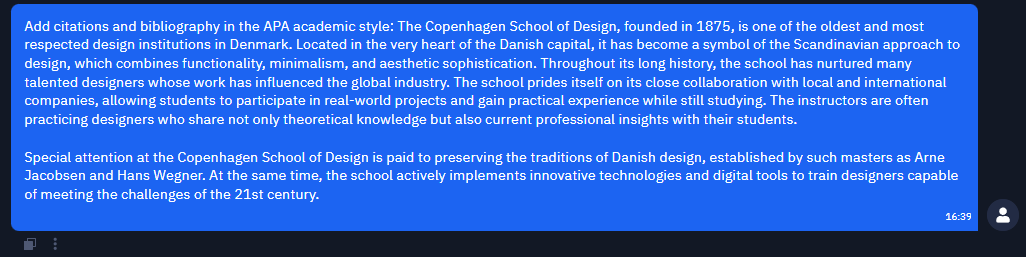
Suppose we take an excerpt from an article without any footnotes or citations. Let's ask it to add the necessary elements in accordance with the APA style:
Exam preparation
Claude can help with exam preparation by providing detailed explanations and definitions of key concepts, creating a preparation and topic plan, and giving tips and techniques for preparing for and taking exams.
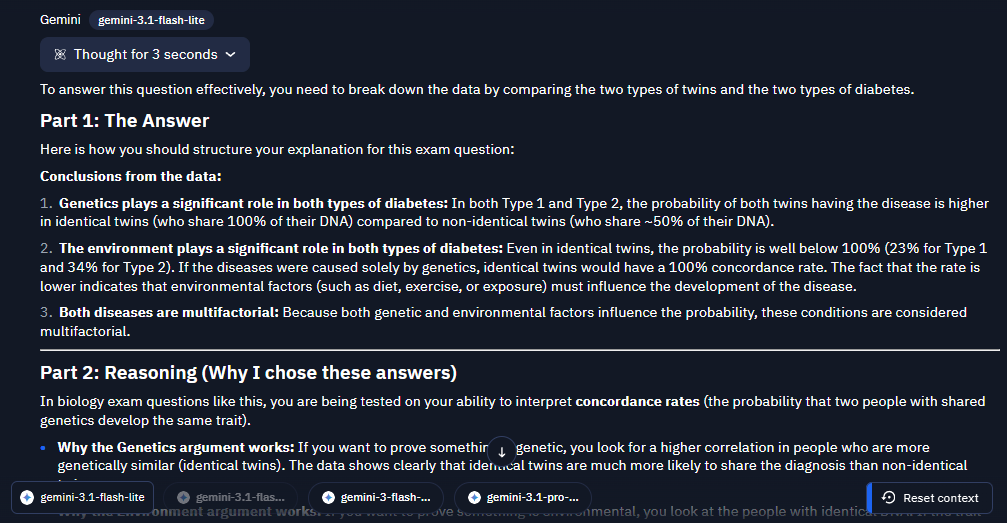
Let's take a question from the 2024 Unified State Exam (USE) in biology and ask Claude to give us explanations and recommendations.
We will make the following request: "Solve this problem and explain why you chose these specific answers, and also give me advice on how best to prepare for this topic." We get the following answer:
Support in learning new languages
Claude can be used as a tool to practice and improve language skills. It can help in learning new vocabulary and grammar, as well as provide practice in reading and writing in a foreign language.
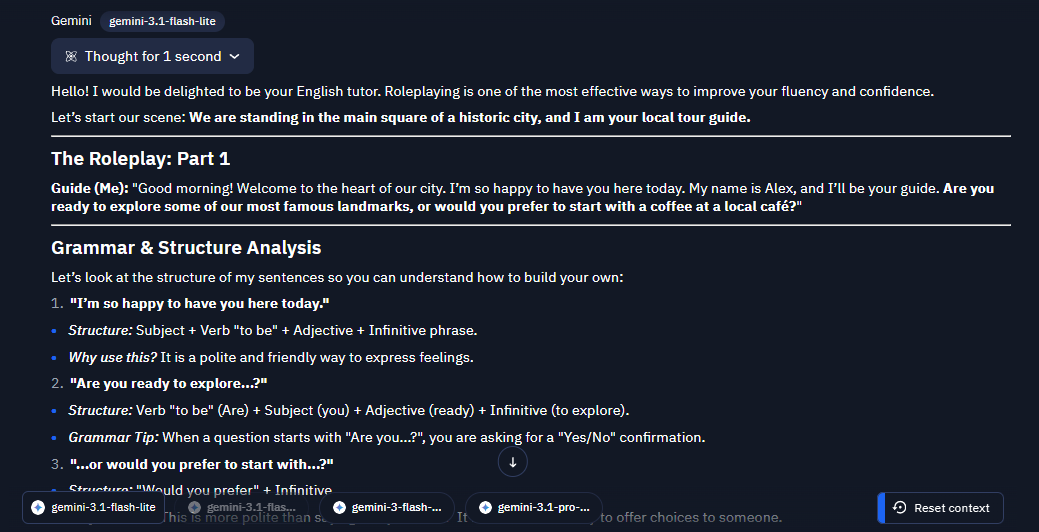
For example, we can ask it: "Take on the role of my English tutor. Let's roleplay a dialogue in English where you are a guide and I am a tourist. At the same time, explain the grammatical structure of your sentences to me, how to answer them correctly, and also provide translations of useful thematic words." Claude might offer the following to this:
In this lesson, we got acquainted with Claude 3.7 Sonnet — a powerful tool that can become your reliable assistant in your studies and beyond. The main thing is to use these tools consciously and creatively so that they enhance your abilities rather than replace them. We will explore each use case of Claude in the educational process in more detail in the following lessons, but for now, let's move on to practice!