Lesson 2: Text Translation
Today we will dive into a fascinating application of ChatGPT - text translation. The widespread use of AI in the translation field opens up new opportunities, not only in a technological sense but also as a source of income. Chat GPT-4, like other GPT models, can interact in multiple languages. However, the efficiency and quality of responses in different languages may vary depending on the training data and experience with a specific language.
Key to Understanding: ChatGPT in Translations
Translation is one of the key areas where ChatGPT demonstrates its capabilities. The ability to process and generate text allows it to translate phrases and paragraphs of text. ChatGPT can interact with text in a huge number of languages, but it works most effectively with English.
Advantages of using ChatGPT include:
- Speed and efficiency: ChatGPT can translate texts faster than a human, allowing it to process large volumes of data in a short time.
- Continuous learning and improvement: Thanks to neural networks, ChatGPT learns and improves, providing higher quality translations.
- Contextual understanding: GPT-4 can better grasp the context and nuances of the source text, which can lead to a more accurate and natural translation.
- Conversational style translation: Chat GPT can be more effective in translating texts with a conversational style or slang, as it is trained on a large amount of conversational material.
- Flexibility: You can use Chat GPT to translate texts between different languages, not limited to the most common language pairs. Although translation quality may vary depending on the language, GPT-4 can provide translations between less common languages that may not be available in some traditional translation systems.
- Processing complex texts: GPT-4 can be useful when translating complex or specialized texts, such as technical documentation, scientific articles, or literary works, as it is trained on a wide range of topics and fields of knowledge.
- Creative and adaptive translation: Chat GPT can offer alternative translation options or adapt the text to better fit the style or cultural specifics of the target language. This can be useful when translating idioms, proverbs, or expressions that have a specific meaning or usage in the source language.
- Interdisciplinary connections: Thanks to its broad knowledge base, GPT-4 can recognize and account for interdisciplinary connections or terms that have different meanings in different contexts, which can improve translation quality.
- Interactivity: Unlike traditional translation systems, Chat GPT can interact with the user, allowing you to clarify context or ask questions for a more accurate translation. This can be useful when the source text contains ambiguities or when the user wants more information about the translation.
However, it is important to understand the limitations:
- Accuracy issues: Despite training and improvement, ChatGPT can make mistakes or offer an inaccurate translation. This is especially true for complex or rare phrases and words.
- Lack of cultural context: ChatGPT may not understand cultural references or nuances that might be important in some texts.
Here is a simple example of how you can use ChatGPT for translation: "Translate to English: Текст (от лат. textus — ткань; сплетение, сочетание) — зафиксированная на каком-либо материальном носителе человеческая мысль; в общем плане связная и полная последовательность символов."
ChatGPT's response:

Translation as a Source of Income: Earning with ChatGPT
With ChatGPT, you have the opportunity to offer translation services:
- Providing translation services: You can start working as a freelancer, offering text translation services. This can be a great way to generate income, especially if you work with large volumes of text.
- Editing translations: Together with ChatGPT, you can not only translate texts but also edit existing translations.
- Creating your own translation app: ChatGPT can be integrated into your own translation application, which can become the foundation for your business.
And now, let's experiment!
Practical Task: Comparing Translations
Task:
The goal of this task is to explore the efficiency of ChatGPT's translation by comparing the translation of the same text, presented in different languages, into Russian.
Instructions:
- Choose a text in the source language. This could be a short news article, a paragraph from a book, a poem, or any other text you want to use. Try to choose a text that contains various aspects of language, such as idioms, complex sentence structures, and specific terminology.
- Find or make translations of this text into three or four different languages. You may need to use online dictionaries or other sources for this.
- Use ChatGPT to translate each of these texts into Russian. Record the results.
- Compare the resulting translations. Pay attention to the differences and similarities between them. Analyze in which cases ChatGPT handled the translation best and why.
Example:
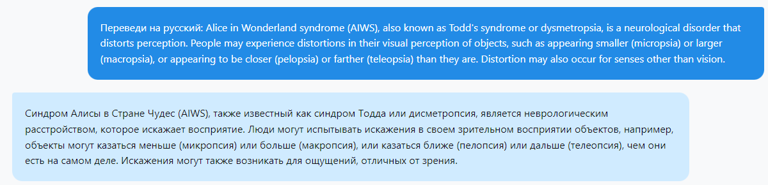
- English: “Alice in Wonderland syndrome (AIWS), also known as Todd's syndrome or dysmetropsia, is a neurological disorder that distorts perception. People may experience distortions in their visual perception of objects, such as appearing smaller (micropsia) or larger (macropsia), or appearing to be closer (pelopsia) or farther (teleopsia) than they are. Distortion may also occur for senses other than vision.”
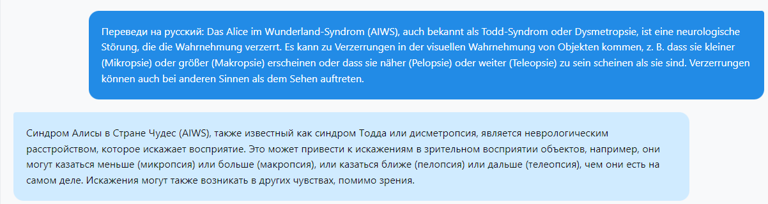
- German: “Das Alice im Wunderland-Syndrom (AIWS), auch bekannt als Todd-Syndrom oder Dysmetropsie, ist eine neurologische Störung, die die Wahrnehmung verzerrt. Es kann zu Verzerrungen in der visuellen Wahrnehmung von Objekten kommen, z. B. dass sie kleiner (Mikropsie) oder größer (Makropsie) erscheinen oder dass sie näher (Pelopsie) oder weiter (Teleopsie) zu sein scheinen als sie sind. Verzerrungen können auch bei anderen Sinnen als dem Sehen auftreten."
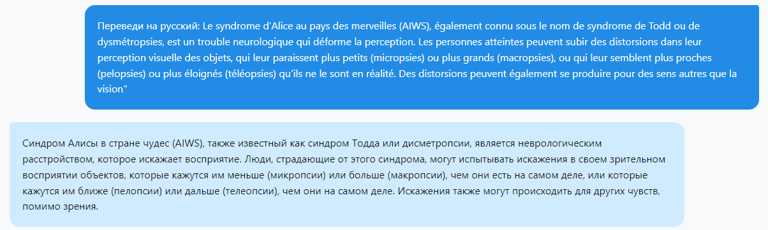
- French: “Le syndrome d'Alice au pays des merveilles (AIWS), également connu sous le nom de syndrome de Todd ou de dysmétropsies, est un trouble neurologique qui déforme la perception. Les personnes atteintes peuvent subir des distorsions dans leur perception visuelle des objets, qui leur paraissent plus petits (micropsies) ou plus grands (macropsies), ou qui leur semblent plus proches (pelopsies) ou plus éloignés (téléopsies) qu'ils ne le sont en réalité. Des distorsions peuvent également se produire pour des sens autres que la vision.”
And now ask to translate each of the texts into Russian.
- From English:
- From German:
- From French:
Conclusion
Using ChatGPT as a translator can be a useful addition to traditional translation tools, but its effectiveness may depend on the specific language and context. For best results, it is recommended to experiment and compare the results with other available translation systems, such as DeepL, Google Translate, Yandex Translate, and many others.
Coupled with copywriting, translations can significantly expand your pool of potential clients - you can not only create content but also prepare its multilingual adaptation! This not only increases your appeal as a contractor but also increases the value of your services.